Workplace Health and Safety
Human Rights
Workplace Diversity and Equality
The Company has established and implemented many regulations for internal staffs such as the “Human Rights Policy” and “Regulations Governing Personnel Management”in accordance with the labor laws and related international human rights standards. The regulations provide clear assurance of the labor rights and interests of the employees including hiring, remuneration, working hours, trainings, promotion and so on conditions without discriminations regardless of one’s gender, race, age, marital status, religion, political stance and family situations. We prohibit any forms of forced labor and conducts of discrimination and prohibit child labor strictly abide to the labor laws.
We have also introduced the Total Productive Maintenance (TPM) activities and occupational health and safety management system. Various hazard prevention measures and implementation are conducted accordingly to provide employees a work environment that is safe and healthy. The HR Department is responsible for the coordination of all employee rights. The Construction & HSE management Department is responsible for the organization of labor safety and health related business. We provide an open and transparent communications mechanism and channels committed to driving a harmonious labor-management relationship
Human Rights Due Diligence Scope and Process
The Company supports and respects international related human rights charters, such as the “The United Nations Global Compact (UNGC)”. We have established various management policies and procedures to protect the legitimate rights and interests of our employees. Through fair compensation and promotion systems, we strive to foster a positive and supportive working environment.
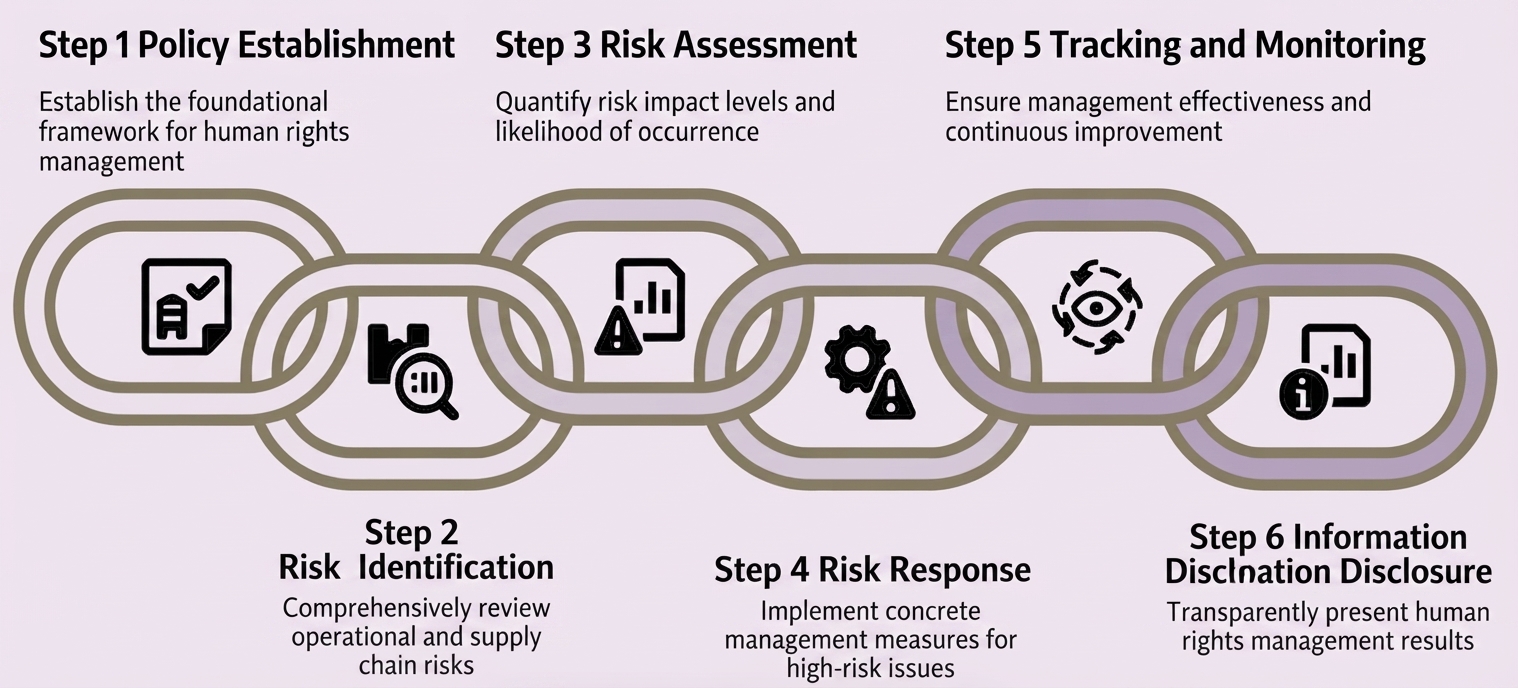
Based on" The Due Diligence Guidance for Responsible Business Conduct(OECD)", the Company has established a systematic human rights risk management process encompassing risk identification, assessment, mitigation, and monitoring. Taking into account our operational scale, industry characteristics, and management capabilities, we prioritize the identification and assessment of human rights risks affecting our employees and Tier 1 suppliers.
During the risk identification and assessment stages, the Company conducts a comprehensive analysis with reference to international human rights standards, human rights issues prioritized by leading domestic and international companies in the same industry, and multiple sources of relevant information to enhance the completeness and objectivity of the assessment.
Human Rights Due Diligence Process
Human Rights Risk Assessment Methodology and Matrix Analysis
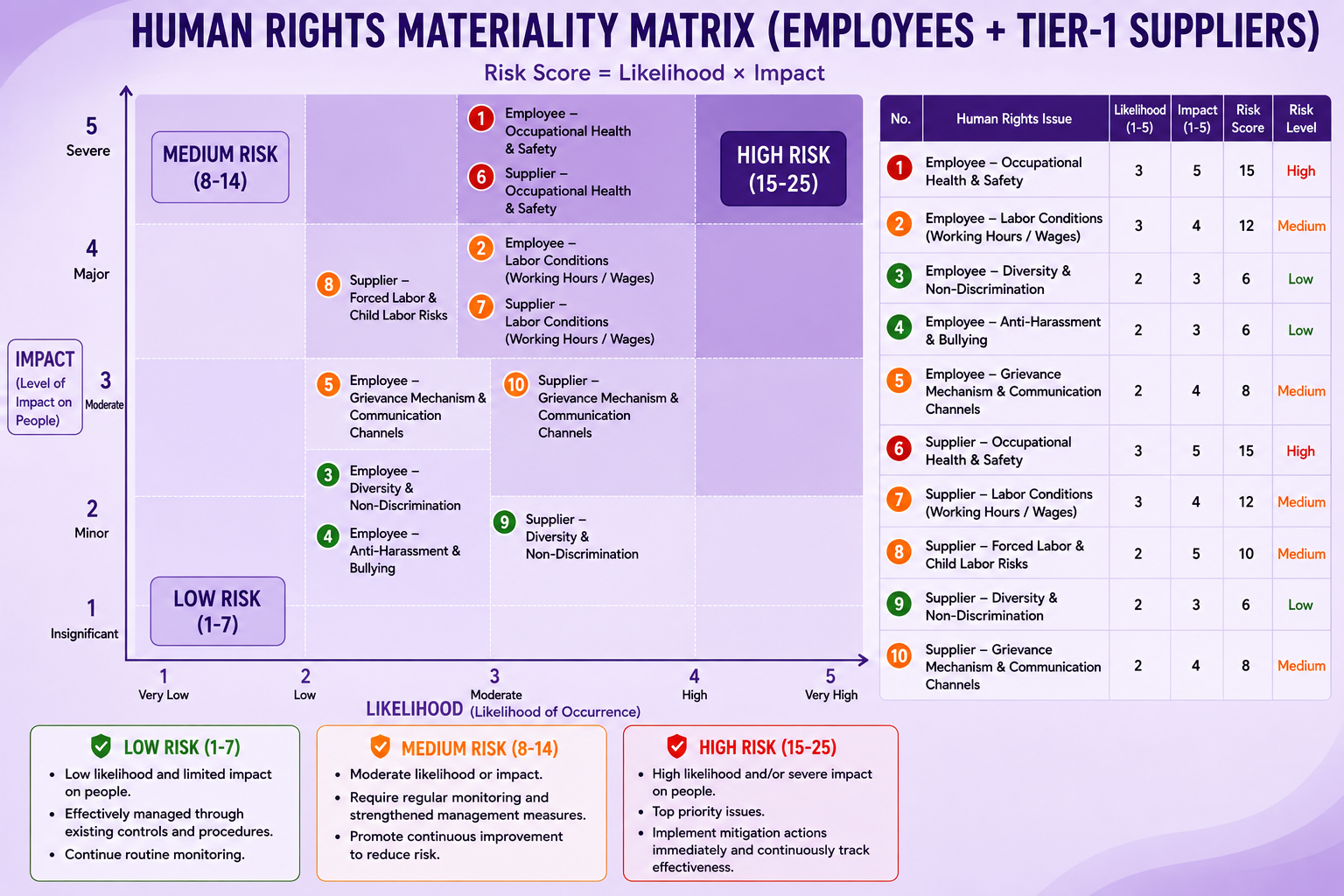
During the human rights risk assessment process, the Company adopts a risk matrix approach and conducts a comprehensive assessment based on two indicators:
“Likelihood of Occurrence” and “Impact Severity.” The product of these two indicators is used as the basis for calculating the risk score to ensure consistency and objectivity in the assessment.
For the Likelihood of Occurrence, the Company evaluates the frequency and probability of each human rights issue based on past operational experience, industry characteristics, and the current management practices. For Impact Severity, the Company considers the potential impacts on employees’ personal safety, fundamental rights, business operations, and corporate reputation in the event that a human rights incident occurs. Based on the results of these two assessments, the Company calculates the risk score by multiplying the scores for Likelihood of Occurrence and Impact Severity, each rated on a scale of 1 to 5. Risk levels are then classified according to the resulting scores. High-risk issues are identified as priority management areas requiring immediate improvement measures and continuous monitoring. Medium-risk issues are incorporated into routine management and periodic reviews, while low-risk issues are continuously monitored through existing management systems.
Human Rights Risk Issues and Management Measures
Based on the identified medium- and high-risk human rights issues, the Company has implemented mitigation and remediation measures, with the following follow-up on their effectiveness:
The Company has established and implemented many regulations for internal staffs such as the “Human Rights Policy” and “Regulations Governing Personnel Management”in accordance with the labor laws and related international human rights standards. The regulations provide clear assurance of the labor rights and interests of the employees including hiring, remuneration, working hours, trainings, promotion and so on conditions without discriminations regardless of one’s gender, race, age, marital status, religion, political stance and family situations. We prohibit any forms of forced labor and conducts of discrimination and prohibit child labor strictly abide to the labor laws.
We have also introduced the Total Productive Maintenance (TPM) activities and occupational health and safety management system. Various hazard prevention measures and implementation are conducted accordingly to provide employees a work environment that is safe and healthy. The HR Department is responsible for the coordination of all employee rights. The Construction & HSE management Department is responsible for the organization of labor safety and health related business. We provide an open and transparent communications mechanism and channels committed to driving a harmonious labor-management relationship
Human Rights Due Diligence Scope and Process
The Company supports and respects international related human rights charters, such as the “The United Nations Global Compact (UNGC)”. We have established various management policies and procedures to protect the legitimate rights and interests of our employees. Through fair compensation and promotion systems, we strive to foster a positive and supportive working environment.
Based on" The Due Diligence Guidance for Responsible Business Conduct(OECD)", the Company has established a systematic human rights risk management process encompassing risk identification, assessment, mitigation, and monitoring. Taking into account our operational scale, industry characteristics, and management capabilities, we prioritize the identification and assessment of human rights risks affecting our employees and Tier 1 suppliers.
During the risk identification and assessment stages, the Company conducts a comprehensive analysis with reference to international human rights standards, human rights issues prioritized by leading domestic and international companies in the same industry, and multiple sources of relevant information to enhance the completeness and objectivity of the assessment.
Human Rights Due Diligence Process
Human Rights Risk Assessment Methodology and Matrix Analysis
During the human rights risk assessment process, the Company adopts a risk matrix approach and conducts a comprehensive assessment based on two indicators:
“Likelihood of Occurrence” and “Impact Severity.” The product of these two indicators is used as the basis for calculating the risk score to ensure consistency and objectivity in the assessment.
For the Likelihood of Occurrence, the Company evaluates the frequency and probability of each human rights issue based on past operational experience, industry characteristics, and the current management practices. For Impact Severity, the Company considers the potential impacts on employees’ personal safety, fundamental rights, business operations, and corporate reputation in the event that a human rights incident occurs. Based on the results of these two assessments, the Company calculates the risk score by multiplying the scores for Likelihood of Occurrence and Impact Severity, each rated on a scale of 1 to 5. Risk levels are then classified according to the resulting scores. High-risk issues are identified as priority management areas requiring immediate improvement measures and continuous monitoring. Medium-risk issues are incorporated into routine management and periodic reviews, while low-risk issues are continuously monitored through existing management systems.
Human Rights Risk Issues and Management Measures
Based on the identified medium- and high-risk human rights issues, the Company has implemented mitigation and remediation measures, with the following follow-up on their effectiveness:
Occupational Safety and Health / Employees and Tier 1 Suppliers
- Laws and Regulations :Occupational Safety and Health Act、Labor Standards Act
- Preventive/Mitigation Measures:
- Promote the SNPM (Sinon-Productive-Management) activities using 6S as foundation and QC technique to strengthen the corporate management.
- Regular inspection and maintenance of the workplace tunnels, lightings, fire control, buildings and so on mechanical equipment that is important to the labor safety and health. This is to ensure the environment and employee personal safety.
- Encourage employees to make innovative proposals, discover work anomalies or cost savings, and conceive improvement plans.
- Each year, organize safety and health educational trainings and disaster prevention drills within the factory on a regular basis for the employees and vendors.
- Conduct identification and evaluation of risks on all types of hazards that might arise from the various processes, activities, facilities, and manufacturing processes that involve personnel, mechanical equipment, raw materials, business methods. Utilize goals and management plans to lower high-risk hazards to achieve zero hazards as the goal.
- Each quarter reviews the source of occupational hazards and the occurrences of major false alert reporting. Develop countermeasures for the root causes.
- Through the supplier management system, occupational health and safety requirements are enforced to provide a safe and healthy working environment, with continuous improvements driven by evaluation, audits, and training and awareness programs.
- At the Zhangbin Plant, a translator is stationed weekly to conduct training sessions for foreign employees on quality awareness and skill development.
- Each year, organize the employee health checkup and health promotion activities. In concert with the employee health checkup results, keep track of the employees with high health risks to support them in their health management.
- Remedial Measures:
- Set up appeal channels to implement employee feedback mechanism and concept of gender equality. Regularly organize monthly meetings, seminars, advocate important company information and for employees to express their opinions.
- Establish incident reporting and investigation mechanisms to identify root causes, develop corrective actions, and monitor their effectiveness to prevent recurrence.
- Provide necessary medical assistance and return-to-work support.
- Management Indicator Performance Tracking:
- No disabling injury cases were reported in 2025.
- The Construction & HSE management Department conducts monthly SNPM (Sinon-Productive-Management) activities (unannounced inspection). Conduct unannounced inspections of environmental safety and health (ESH) and 6S conditions in office and plant areas. Following up on non-compliance issues at the Wang-Tien Factory area and Zhangbin Plant, all corrective actions achieved a 100% completion rate.
- The health promotion activities have seen a cumulative total of 2,903 participants, with 2,570 participants at the Wang-Tien Factory area, and 333 participants at the Zhangbin Plant.
Labor Conditions / Employees and Tier 1 Suppliers
- Laws and Regulations :Labor Standards Act、Employment Service Act
- Preventive/Mitigation Measures:
- Established a complete personnel charter and conduct regular reviews and corrections.Clearly stipulate the rights, obligations, and management matters of both parties for labor and management. Our personnel rules and regulations are available on our intranet for employees to access, and we also explain labor rights and benefits to new employees on the day they come on board and during new employee orientation.
- An attendance system is used to verify the employees' working hours. If the daily working hours are exceeded, the system will notify the employees to check the facts and the need for overtime work. In addition, the overtime system is used to control overtime applications. Employees are allowed to work overtime only after they agree to it, after the supervisor in charge has evaluated the necessity of working overtime, and the system has verified that it meets the requirements of the Labor Act on Labor Attendance and Leave.
- The personnel unit of every department will regularly provide the employee leave chart to the unit's manager to ensure the employees make proper leave arrangements.
- Regularly organize educational trainings on labor laws to assist managers and employees from the personnel unit to construct a correct management concept.
- Conduct employee engagement surveys to identify and understand employees’ needs and expectations.
- The Company has established a “Supplier Code of Conduct” governing labor rights, requiring compliance with applicable regulations to ensure reasonable working hours, remuneration, and safe working environments, with adherence enforced through assessments and audits.
- Remedial Measures:
- Established employee grievance and complaint channels to enable employees to promptly communicate and report concerns in the event of relevant risk incidents.
- Implement corrective actions for non-compliance and, where necessary, revise relevant policies, systems, or management measures.
- Require suppliers to develop and implement corrective action plans.
- Management Indicator Performance Tracking:
- One case of penalty was imposed due to violation of the Labor Standards Act. During a peak operational period, certain unit-level working hours management was not fully adequate. Following an internal review, management processes have been improved, and ongoing training has been implemented to strengthen regulatory compliance, ensuring that employee working hours arrangements comply with legal requirements.
- The Company hired 27 employees with disabilities and assigned them to appropriate duties according to their qualifications. This was beyond the statutory requirement of hiring at least 13 people with disabilities.
- In 2025, the Company continued to employ a total of 21employees aged 65.
Mechanisms and Communication Channels / Employees and Tier 1 Suppliers
- Laws and Regulations :Act for Settlement of Labor-Management Disputes、Guidelines for Preventing Unlawful Infringement in the Performance of Duties
- Preventive/Mitigation Measures:
- Promote grievance procedures and employees’ rights to ensure that all employees and suppliers have convenient access to the grievance mechanisms.
- Strictly protect the identity of whistle blowers and encrypt all grievance-related information and communication records.
- Clearly communicate at the workplace and in contracts that dismissal, transfer, reduction in pay, or any form of retaliation or threats against whistle blowers are strictly prohibited.
- Regularly review the types of grievances received and identify areas for improvement.
- Establish dedicated grievance channels and feedback mailboxes for employees and suppliers to communicate concerns and express any grievances or concerns.
- Remedial Measures:
- Investigate grievances in accordance with established procedures and provide necessary remedial measures.
- If whistleblowers are subjected to dismissal, threats, or involuntary transfer, impose the most stringent contractual sanctions, require immediate reinstatement, and take disciplinary action against responsible management personnel.
- If suppliers deliberately obstruct grievance procedures or conceal serious violations, classify them as high-risk suppliers and implement measures such as suspension of orders or termination of the business relationship.
- Management Indicator Performance Tracking:
- The Company conducted awareness training on prevention of unlawful workplace conduct (including sexual harassment), with a total of 1,855 employees participating, achieving a 100% completion rate.
- Wang-Tien Factory area held 4 labor-management conferences and 4 safety and health committee meetings; Zhangbin Plant held 4 labor-management conferences during the year.
- No human rights-related grievances or complaints were reported by employees or suppliers in 2025.
Forced Labor and Child Labor Risks / Tier 1 Suppliers
- Laws and Regulations :Labor Standards Act、Employment Service Act
- Preventive/Mitigation Measures:
- Prohibit all forms of forced labor.
- Enter into employment contracts in accordance with applicable laws and regulations.
- Prohibit the withholding of employees’ identification documents or the imposition of improper fees.
- Establish identity and age verification mechanisms.
- Prohibit young workers from performing hazardous work.
- Suppliers are required to sign a declaration within the “Supplier Code of Conduct” affirming a prohibition on the use of child labor, with compliance with human rights standards and regulatory requirements ensured through audits and ongoing communication.
- Require corrective actions within a specified timeframe for deficiencies identified during audits, followed by review and follow-up to verify the effectiveness of the corrective actions.
- Remedial Measures:
- Promptly investigate any identified violations and require suppliers to submit specific, time-bound remediation and corrective action plans.
- Assist affected employees in restoring their rights and entitlements.
- If a Tier 1 supplier refuses to implement corrective actions, conceals material facts, or is involved in a severe violation, take decisive contractual enforcement measures, including suspension of orders or termination of the business relationship.
- Management Indicator Performance Tracking:
- All the suppliers are over 18 years old. There have been no incidents in the use of child labor.
- Between 2022 and 2025, 24 additional copies of “Supplier Code of Conduct Commitment” and 36 copies of“Declaration of Non-use of Conflict Minerals” were recalled.
- In 2025, 11 new crop protection raw material suppliers were added; 2 new plastic raw material suppliers were added. The suppliers were asked to conduct a self-assessment of the QHSE questionnaire. After assessment, no significant negative impacts were found, and all of them became the qualified suppliers of the Company.